
COVID-19: DiLX prioritizes the safety of its employees and customers - Learn More
logo
  • InsightsOpen in new tab
  • Careers
  • SECTORS WE SERVE
    • Automotive Ecosystem
    • Overview
    • Retail
    • Manufacturers & Importers
    • Dealers
    • Remarketing
    • Aftermarket
    • Independent Garages
    • Parts Groups
    • Service Maintenance and Repair
    • Mobility
    • Lease & Rentals
    • Fleet Operators
    • Insurance
  • AF-X Suite
    • What is AF-X?
    • Overview
    • AF-X Implementation
    • CONNECT
    • AF-X Spaces
    • AF-X 360
    • AF-X Sales
    • OPERATIONS
    • AF-X Service
    • AF-X Fleet
    • AF-X Parts
    • DATA
    • AF-X Intel
    • AF-X Connectors
    • AF-X Exchange
  • READY-TO-DEPLOY
    • AF-X DealerOps
    • Smart Service Planner
    • Zero Touch Service
    • Digital Service Order
    • Showroom Sales
    • Lead To Order
    • C360
    • Leads Manager
    • AF-X Mobility
    • Fleet Operations
    • Lead to Order
    • Remarketing Platform
    • Stock Management
    • Car Rental
    • Customer Apps and Platform
    • AF-X Garage
    • Smart Service Planner
    • Digital Service Order
    • Zero Touch Service
    • Parts Stock Manager
    • Customer & Vehicle Management
    • Tyre Hotel & Service Booking
    • AF-X PartsCom
    • Product Information Management
    • Electronic Parts Catalogue
    • Parts Stock Manager
  • CONSULTING
    • Overview
    • Digital Transformation
    • Technology Strategy
    • Future Mobility
  • Services
    • DIGITAL ENGINEERING SERVICES
    • Product Engineering
    • Cloud Transformation
    • Digital Centre of Excellence
    • Intel Services
    • Cognitive BI
    • Connected
    • CYBERSECURITY
    • AutoSecure
    • STAFF AUGMENTATION
    • AutoMPS
  • ABOUT US
    • Who We Are
    • Leadership Team
    • Corporate Social Responsibility
    • Alliance & Partners
    • Contact us
  • Insights
  • Careers
  • Home
  • Segments ▾
    • OEMs & Importers
    • Dealers
    • Garage Chains
    • Fleet & Logistics
    • Lease & Rental
    • Insurance
    • Parts & Components
    • Collision Repairers
  • Automotive IT Trends ▾
    • All Trends
    • Big Data
    • Cloud Computing
    • Connected Cars
    • IoT
    • Machine Learning & AI
    • Augmented Reality
  • Whitepapers
  • Case Studies
  • Newsletter
Home » Insights » How connected cars are driving connected payments

How connected cars are driving connected payments

Posted on Mar 14, 2018  |  Category: Automotive IT Trends
How connected cars are driving connected payments
Technologies associated with IoT are inexpensive, low powered and frequently based on common software platforms. Recent rapid development in the automotive/haulage industries allows the integration of this tech into cars/trucks. These developments have coincided with the simultaneous rise in fintech with the use of technology supporting financial services such as payments, fostering a commonality of innovative development across these domains. There are innovative opportunities created by merging one industry with another and also driven by the IoT trend. For example, this can be illustrated by the implementation of an autonomous “pay at pump” use case showing how the integration of IoT and payments technology into car IVI systems and fuel pumps will allow the financial transaction associated with buying fuel to be handled completely autonomously. The deployment of computer vision technology for authentication, and connectivity for communication with payment authorities, will also facilitate autonomous payments in a large range of scenarios including for example road- toll payments too. Modern cars generally include an in-vehicle infotainment (IVI) system. These systems usually combine multimedia, navigation, radio and telephony functions. Software to execute these functions requires a sophisticated operating system (OS) to provide underlying services. Rather than develop a fully custom OS, automotive manufacturers (OEM) and Tier 1 suppliers tend to adopt existing, licensed OSs, such as Linux, Windows or QNX on which to build IVI systems. This combination of application software, complex OS and SoC is similar to the approach taken to build mobile phones. Application software such as Apple Pay, Google Pay and Samsung Pay in combination with Near Field Communication (NFC) or Bluetooth Low Energy (BLE) peripheral hardware and techniques like Host Card Emulation (HCE) and QR codes allow a mobile to be used as a payment device. It is therefore possible to build payment technologies into automotive IVI systems, enabling the car to effectively also become a payment device.

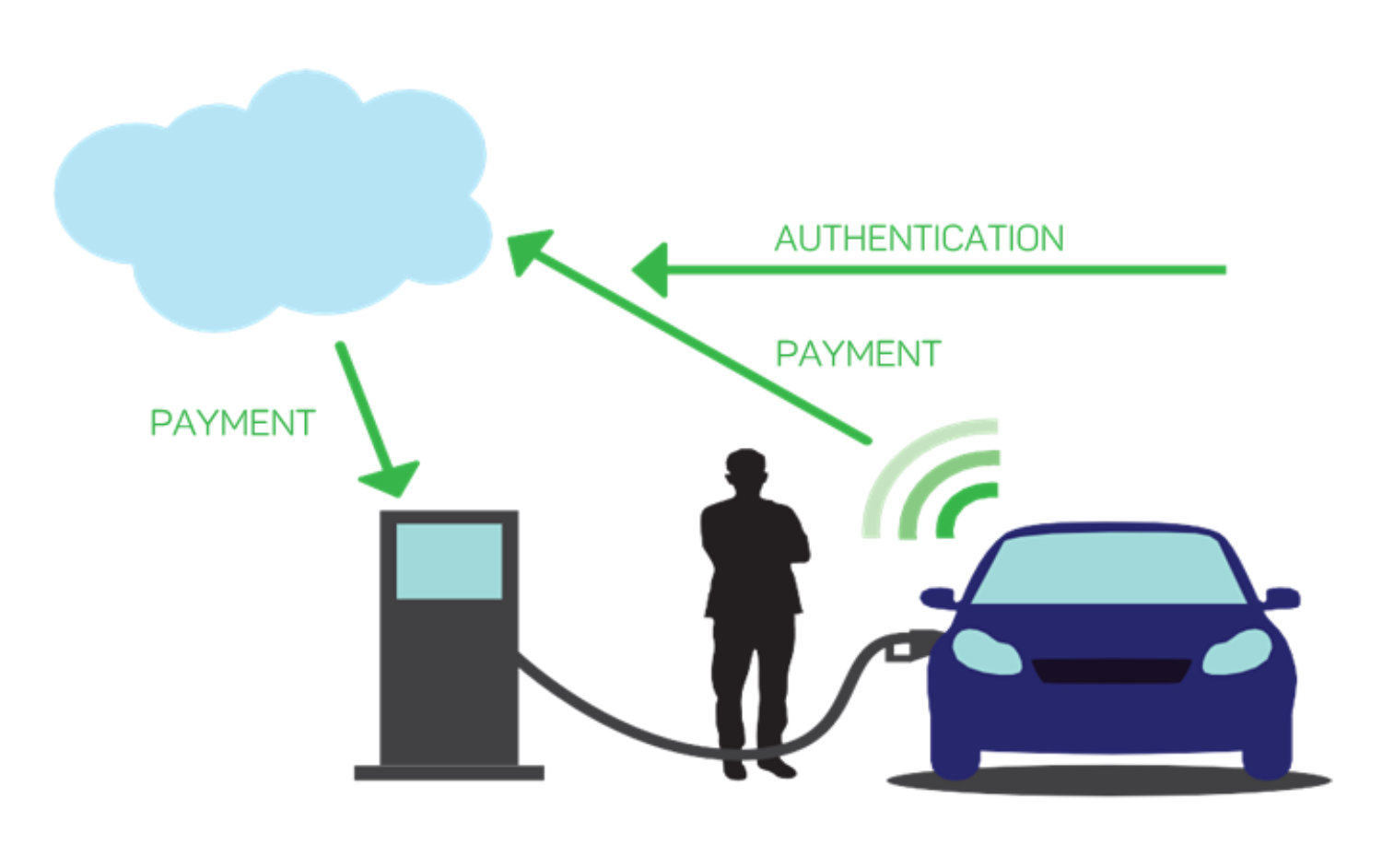
Pay at the pump

The figure above illustrates how a connected car pay at pump model could work:
  • The driver fuels the car
  • When triggered by the driver, the IVI system communicates with the pump, using a secure, short range wireless connection, providing authentication. This may happen whilst refueling is in progress
  • When the driver has completed refueling and the authentication process, the car transfers money to the fuel company electronically, over the internet
The most significant software work required is porting and enabling of existing OS features and hardware support for the target devices. It is possible that device drivers for specific hardware modules may be unavailable directly, e.g. NFC, encryption, DSP hosted algorithms, MMU schemes, TEE. However, in such cases, it is likely that the semiconductor vendor will provide a base driver for a reference platform. Application software may still need to be developed depending on the underlying APIs and the nature of existing applications. At a minimum, applications will require porting from existing mobile platforms, considering different input methods, display geometry, hardware platforms, security and safety requirements.

Pump technology

For the connected car pay at pump use case we also need to consider the necessary changes to the fuel pump. It is already commonplace to allow a user to pay for their fuel at the pump, using a payment card. In this regard, the pump includes the hardware and software of standalone payment terminals. These terminals frequently include an embedded OS, such as Windows or Linux – this implies that the pump is designed in such a way to make software modification relatively simple. Generic payment terminals usually permit chip, magnetic strip and contactless modes of payment. Existing Pay at Pump solutions are mostly based on chip and PIN; some form of enhanced contactless payment must be added to the pump. As the payment terminals are based on embedded OSs, the necessary protocols and hardware abstractions are already available. The addition of hardware support for contactless payment is also similar to the IVI scenario.

The future

All the necessary software and hardware components together with the processes for the creation of the connected car pay at pump use case are currently available. The creation of a commercially viable, fully integrated solution is the next step and there are no technical or regulatory barriers to doing so. While connected car payments is one example there are myriad other potential use cases including: road tolls, parking, car taxation, servicing, regulatory periodic vehicle testing, drive-thru restaurants, car rental, insurance and in-car entertainment. It is anticipated that the overlap of the automotive and fintech sectors will come to fruition in 2018, as IVI systems mature to provide a more generic (if not open) platform on which third-party developers can provide innovative new software and services. The IVI system is at the heart of the connected car; in the same way that the mobile market rapidly expanded as mobile platforms matured, so too will the connected car market. The majority of large businesses now have distinct digital and mobile strategies for selling and deploying their products and services. Within a few years, it is likely that many of these will also have a distinct connected car strategy.  Such strategies will also include an element of monetization which requires integrated payment solutions. Will mobile payment technology spawn a platform to support connected cars — car payments? The rise of the fintech companies, challenger banks and changes to regulation of the financial services market in the EU have all stimulated significant innovation. In particular, the Payment Services Directive (PSD2) is allowing smaller financial organisations to provide services competitively. PSD2 is focused on electronic payments and will therefore extend the use of such payments further. PSD2 compels banks to allow 3rd parties to extend electronic payment options – for example to assign a payment card to the bank account or to initiate a money transfer from the account. The regulation changes are also allowing finance companies to sell each other’s products and services, broadening competition and creating niches in which the smaller fintech companies can innovate. This is changing the world of mobile payment technology. It is also likely to have the same impact on connected car payments. Further, the new fintech services being developed for deployment on mobile will also be deployed in an automotive context. In the embedded and automotive domains, the most significant opportunities for innovation in this area arise from the integration of IoT solutions. Sensors being added to cars and the smart cities in which they drive provide a plethora of potential new services, such as smart parking and insurance. These services will require seamless payment solutions as we increasingly expect to be able to make such payments, particularly from within our cars.
Author –  Jim Carroll, CTO, Mobica Courtesy of Mobile Payments Today

Disclaimer: AutoFacets doesn't claim or takes credit for images/content/videos/whitepapers/etc. featured on its website. All images/content/videos/whitepapers/etc. are copyrighted to its respectful owners and are shared for informational purposes. This sharing is not intended to infringe the copyrights of respective authors.
Back to Insights

LET'S DELIVER EXPERIENCES TOGETHER!

    Head Offices

    nl The Netherlands
    Maria Montessorilaan 5,
    2719 DB Zoetermeer
    Phone: +31 (0) 79 3200 980

    indiaIndia
    8th Floor, Corporate House,
    Bodakdev, Ahmedabad - 380054
    Phone: +91 79 2685 2554

    For more details, write to us at:
    info@autofacets.com

    Find Us Near You!

    Global Offices

    • Belgium Belgium
    • Canada Canada
    • Denmark Denmark
    • Finland Finland
    • France France
    • Germany Germany
    • Iceland Iceland
    • Norway Norway
    • southafrica South Africa
    • Sweden Sweden
    • uaeUAE
    • UK UK
    • USA USA

    For more details, write to us at:
    info@autofacets.com

    Find Us Near You!

    AF-X Suite

    • Overview
    • AF-X Implementation
    • AF-X Spaces
    • AF-X 360
    • AF-X Sales
    • AF-X Service
    • AF-X Fleet
    • AF-X Parts
    • AF-X Intel
    • AF-X Connectors
    • AF-X Exchange

    Client Sectors

    • Overview
    • Retail
      • » Manufacturers & Importers
      • » Dealers
      • » Remarketing
    • Aftermarket
      • » Independent Garages
      • » Parts Groups
      • » Service Maintenance and Repair
    • Mobility
      • » Lease & Rentals
      • » Fleet Operators
      • » Insurance

    READY-TO-DEPLOY

    • AF-X Dealerops
    • AF-X Mobility
    • AF-X Garage
    • AF-X PartsCom

    Services

    • Digital Engineering Services
      • » Product Engineering
      • » Cloud Transformation
      • » Digital Centre of Excellence
    • Intel Services
      • » Cognitive BI
      • » Connected

    Consulting

    • Overview
    • Digital Transformation
    • Technology Consulting
    • Future Mobility

    Follow
    Our Thinking

    • LinkedInOpen in new tab
    • YouTubeOpen in new tab
    • TwitterOpen in new tab

    ABOUT US

    • Who We Are
    • Leadership Team
    • Corporate Social Responsibility
    • Alliance & Partners
    • Contact us

    © 2026 COPYRIGHT AutoFacets - All Rights Reserved.

    Privacy Policy | Terms of use | Disclaimer
    f logoOpen in new tab

    Sign up for our newsletter!

    close

      Let's Get in Touch

      close

        Download Case Study

        close

          Please fill the form to download the case study.
          X
          We value your privacy.
           This website uses cookies and similar technologies to improve your browsing experience, measure our audience, collect useful information, and provide you with relevant content. By selecting “Accept & Continue”, you confirm that you provide your consent for the use of your information, and have read and agree to our Privacy Policy and Terms of Use. .
          Cookie settingsAccept & ContinueDecline
          Manage consent

          Privacy Overview

          This website uses cookies to improve your experience while you navigate through the website. Out of these cookies, the cookies that are categorized as necessary are stored on your browser as they are essential for the working of basic functionalities of the website. We also use third-party cookies that help us analyze and understand how you use this website. These cookies will be stored in your browser only with your consent. You also have the option to opt-out of these cookies. But opting out of some of these cookies may have an effect on your browsing experience.
          Necessary
          Always Enabled
          Necessary cookies are absolutely essential for the website to function properly. These cookies ensure basic functionalities and security features of the website, anonymously.
          CookieDurationDescription
          cookielawinfo-checkbox-analytics11 monthsThis cookie is set by GDPR Cookie Consent plugin. The cookie is used to store the user consent for the cookies in the category "Analytics".
          cookielawinfo-checkbox-functional11 monthsThe cookie is set by GDPR cookie consent to record the user consent for the cookies in the category "Functional".
          cookielawinfo-checkbox-necessary11 monthsThis cookie is set by GDPR Cookie Consent plugin. The cookies is used to store the user consent for the cookies in the category "Necessary".
          cookielawinfo-checkbox-others11 monthsThis cookie is set by GDPR Cookie Consent plugin. The cookie is used to store the user consent for the cookies in the category "Other.
          cookielawinfo-checkbox-performance11 monthsThis cookie is set by GDPR Cookie Consent plugin. The cookie is used to store the user consent for the cookies in the category "Performance".
          viewed_cookie_policy11 monthsThe cookie is set by the GDPR Cookie Consent plugin and is used to store whether or not user has consented to the use of cookies. It does not store any personal data.
          Functional
          Functional cookies help to perform certain functionalities like sharing the content of the website on social media platforms, collect feedbacks, and other third-party features.
          Performance
          Performance cookies are used to understand and analyze the key performance indexes of the website which helps in delivering a better user experience for the visitors.
          Analytics
          Analytical cookies are used to understand how visitors interact with the website. These cookies help provide information on metrics the number of visitors, bounce rate, traffic source, etc.
          Advertisement
          Advertisement cookies are used to provide visitors with relevant ads and marketing campaigns. These cookies track visitors across websites and collect information to provide customized ads.
          Others
          Other uncategorized cookies are those that are being analyzed and have not been classified into a category as yet.
          Save & Accept