
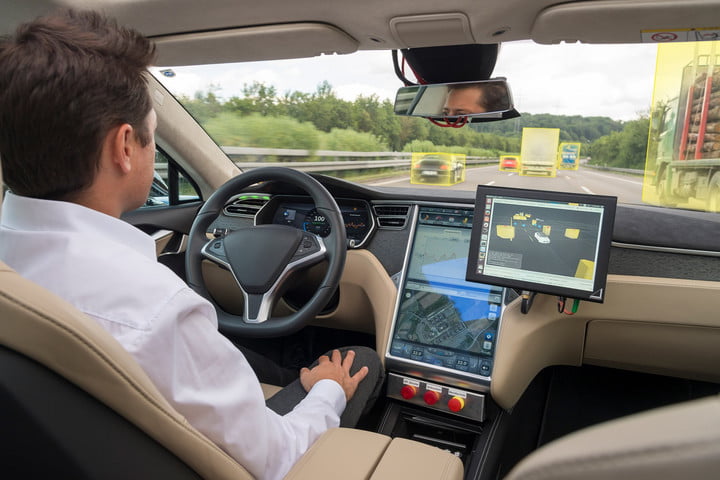
AUTONOMOUS DRIVING, RAIN OR SHINE
The project calls for the launch of a level 4 or 5 car, meaning one that can drive itself in a variety of conditions without requiring human intervention. Fausten explained it will be able to operate in autonomous-only mode on sunny days or in inclement weather, in broad daylight or at night, and on several different types of roads. Prototypes will participate in an extensive pilot program before Daimler and Bosch release the technology to the general public. Details about the program still need to be finalized, so what we know about it is murky at best — we can’t even tell you its name yet. It will start in the second half of 2019 in a major city located, appropriately, in California’s Silicon Valley area. The cars that will participate in the pilot program will be purpose-designed vehicles developed and built by Mercedes, and they’ll initially operate through a ridesharing service available only on select routes. More routes will be added as the program grows, but it’s too early to tell how many cars will hit the streets.
“We are working as fast as we can but also as thoroughly as we can.”
Once the automotive and tech industries’ darling, autonomous technology has been vilified after a Volvo XC90-based prototype built and operated by Uber struck and killed a 49-year old woman named Elaine Herzberg as she crossed a street in Arizona. Critics collectively raised their tone when the circumstances of the crash became clearer; the safety driver was watching Hulu before the impact, according to investigators, and the prototype’s software may have chosen to ignore the pedestrian. The snafu increased the pressure regulators put on companies testing autonomous cars and boosted the public’s skepticism about so-called robot cars.
Daimler and Bosch firmly believe they’ll manage to avoid finding themselves entrenched in a similar situation.
“We are not in the position to comment on recent accidents,” Dr. Uwe Keller, Daimler’s head of autonomous driving, told Digital Trends. “I would rather focus on what we are doing on our side to avoid anything happening to our program. We are having a very careful design process where we evaluate all use cases and figure out what can happen on the roads. When we test, we drive on public roads with people on board who are trained and well certified. From our side, we think we do our best to make driving safe in the testing and prototyping phase.”
Fausten echoed his colleague’s comments. “We are working as fast as we can but also as thoroughly as we can,” he told us.
 Open in new tab