
Introduction
Every industrial report you read today begins with “owing to the effects of the COVID-19 pandemic..” or “The COVID-19 pandemic has disrupted the…” Every industry has had to bear the brunt of the pandemic in one way or another. One of them is the Automotive sector that has witnessed a violent graph from Mar’19 – till date. Let’s start from the beginning. Before the COVID-19 pandemic hit the world, the production and distribution of Electric vehicles were riding the high wave. With over 2 million EV’s sold at the beginning of 2019, the automotive market reached its helm when it all came down to people’s ability to move around freely due to the virus. The pandemic did bring down the sales of cars and vehicles, in general, but it also built up a sense of seclusion and protection that cars provide as opposed to public transports and open two-wheelers. Now, this paradoxically set situation caused a wired response to buying and selling of EVs in a major part of Europe and China.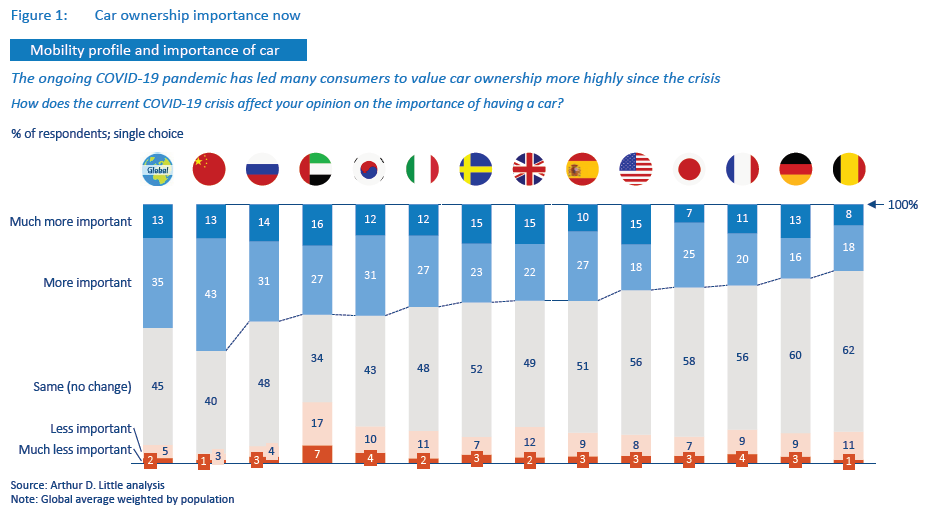
Image Source:- www.adlittle.com
Understanding Customer Preferences By Launching Into Upgraded Models
In the current scenario, four megatrends are circling the automotive industry, namely;- Autonomous Driving
- Sharing Economy
- Connectivity
- Electrification
- Electrification of cars is all set to increase in the 3-wheeler and 2-wheeler segment and establish complete sustainability
- Electric vehicles branch out into two different parts; 1) Battery Electric Vehicles (BEVs) & 2) Plug-in Hybrid Electric Vehicles (PHEVs)
- BEVs draw power solely from the battery, whereas PHEVs are a hybrid model that can run on battery for a short trip and petrol or diesel for longer trips.
- The significant growth of EVs up to 2030 will present major opportunities and challenges for traditional original equipment manufacturers (OEMs), new-entrant OEMs, captive finance companies, and various dealerships.
- Sales of EVs grew by 15% in 2019, driven by the growth of BEVs in Europe (+93%) and China (+17%)
- In the European region, the Nordics & Netherlands continue to lead the way where the former holds a 56% share in the sales of EVs.
What Is The Future Of Automotive Sales?
The future of automotive sales lies in truncating the channel of sales by implementing digital methods.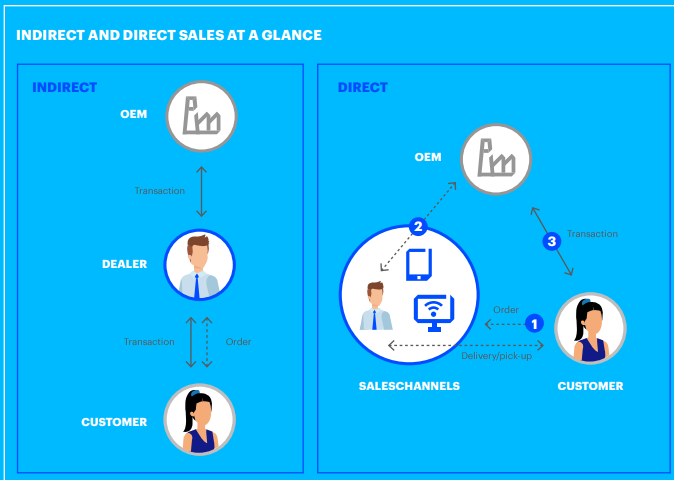
Image Source:- www.accenture.com
As is depicted by the diagram, the indirect channel places the dealer in the middle of the entire transaction, leaving no room for the OEMs to thrive on their own. The direct method, on the other hand, allows each party to communicate with each other for better price flexibility. From this orchestration, we can derive three crucial solutions to drive automotive sales amidst the pandemic.
 Open in new tab